Wednesday, August 5, 2026

Exciting things to come


If you're following things happening in the garden, you'll know that we had a July 11th One City Day event where we planted loads of plants at the Triangle Garden. 

There were lots of volunteers - and of note was a large contingent of friends and family of Jen! Her husband André organized the turnout, and even brought donuts so... obviously that was a hit!

In other news, this very website is getting an update by our longtime friend Aditi (whose company Vetiver does enterprise UX design)  This is a huge endeavor so to say we're grateful is an understatement. 

Lastly, Moumita and Jen are teaming up to apply for a Community Challenge Grant so we can fund the work to renovate the Triangle Garden, along with other hardscape updates that are needed at PG and PRG. OMG, this is a big deal!


Saturday, February 7, 2026

All the new news


Last time I posted it had been a while… And now it’s been a real, real while! But we’re back with some great news.

After the SFPA dissolved, we were left with no money and no insurance so we limped along with the garden for quite some time. 

However, thanks to volunteer Jen who helped me navigate all the tedious paperwork we're back with a new fiscal sponsor who allows us to behave as a nonprofit. Greening Projects have signed on and we can now accept donations and get back to work. A round of applause for Jen, please!


Our volunteer day today was small, but perfect, With sunny weather and lots of smiles. Matt, Leslie, Alex and Chad helped weed bucket loads of weeds and plant a bunch of plants that we received as donations from our friends at Devil Mountain Nursery. Thank you ALL!


We will be having another workday next weekend, so stay tuned for more details on that because it’s part of a wider event happening in Potrero Hill!

And with such an abundance of rain and warm weather that followed that the gardens are full of luscious weeds right now! If you visit, please pull a weed! Imagine if every garden visitor pulled one weed every day… What a difference that would make.

Monday, December 4, 2023

It's been a while

We've had workdays, we've rescheduled workdays, but we've been there - cleaning, pruning, picking trash and planting plants. Life has just been too busy to post much about it!

Here are some photos from recently months.  Recently planted 7 Agave filifera - three were stolen 2 weeks later.  Planted 6 Echium pininana - they're doing great. The vine on the arch died so we removed it. The Hakea needed to be removed, and Chris set about it!


Wednesday, March 1, 2023

Wildlife Profile: California Slender Salamander

Is it a worm? Is it a tiny snake?! No! It's a California Slender Salamander. A resident species at Pennsylvania Garden, at first I thought we had tiny little snakes but was excited to learn that they are in fact a lungless salamander, and a very cute one at that.

Name: California Slender Salamander (Batrachoseps attenuatus)
Class: Amphibian
Length: 7-13cm, 5.5"
Geographical Distribution: The coastal mountain areas of Northern California, a small part of the western foothills of the Sierra Nevada, California, in patches of the northern Central Valley of California, and in extreme southwestern Oregon.

In the right places - that is, shady, moist gardens, woodlands and forests - this salamander can be easily found. Especially at night, when you'll see them walking around during or after heavy rains in the winter and spring. Turn over a rock at PG or PRG and you're pretty likely to see one, at first coiled up but suddenly squirming away as it tries to escape being seen. 

They look like tiny brown or black snakes, or even worms, but you'll see four miniature legs that are a dead giveaway to ID them. And while they have tiny legs, they have no lungs at all.They breathe through their skin, in fact.

Another oddity is that their red blood cells don't have a nucleus. In general, red blood cells in mammals lack a cell nucleus when mature, and the red blood cells of other vertebrates have nuclei. The only known exceptions are salamanders of the genus Batrachoseps like the Slender Salamander, and fish of the genus Maurolicus.

If you try to pick one up, do be careful of their tails, which they can detach in order to escape. Don't worry - they will grow back, but it's certainly not ideal for them to be always growing tails...

These salamanders lay eggs as early as December. Clutches contain approximately five to twenty eggs, but five to ten different females may use the exact same egg laying site. Hatching around March or April, and in their 7-10 year lifespan they can grow to 5.5" long.

Monday, February 13, 2023

Garden Conservancy Open Days

We're featured in the Garden Conservancy's Open Days program!  The mission of The Garden Conservancy is to "preserve, share, and celebrate America's gardens and diverse gardening traditions for the education and inspiration of the public."

During their Open Days you can tour private gardens and hidden gems all over the USA. A little about the open days from their website:

Fueling America’s passion for gardens, The Garden Conservancy’s Open Days program annually celebrates the country’s most exciting, creative, and innovative private gardens. Open Days is made up of a nationwide community of gardeners and garden enthusiasts teaching and inspiring each other and the public. From expert to novice, there is no better way to improve as a gardener than by experiencing a diverse range of gardens, and gardening traditions, firsthand. 

You can get tickets to the private gardens on their website, but of course our garden is always open, and always free. When's the last time you visited? Drop by and see what's up!

Saturday, February 4, 2023

Rainy volunteer day

Our volunteer day today had rain in the schedule, but really it was a light mist so no big deal. Matt and I planted three Agave parryi ssp truncata and I weeded... something we're all going to need to do a lot more of soon! 

Chris joined us and planted five Artemisia "Powis Castle", and then worked on removing an Agave salmiana that had flowered. It was a big job and he was mostly successful! completely successful in freeing it from the dirt, although the darn thing is so heavy we're going to need help moving it from that spot.

Matt and I then went down to PRG and planted five Agave parrasana and seven Muhlenbergia capillaris - a lovely grass with fluffy pink flowers in the fall. Sarah joined us and cut back some Salvia leucantha that really needed it on one of the BRC's too!

Wednesday, February 1, 2023

Checkup and propagation

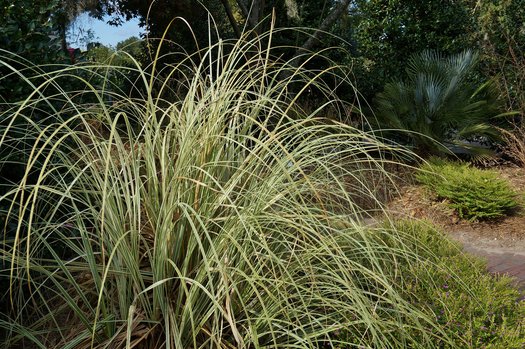
Matt and I went to PRG on Sunday to harvest some plants. Our Cortaderia selloana "Gold Band" and "Silver Comet" plants are very hard to come by because California has banned the sale of pampas grass. Why? Well it's a  horribly invasive plant and very difficult to get rid of. However, these variegated hybrids are sterile, meaning they don't produce viable seeds - not a single one in all these years! So if we want more, we have to dig up parts of the plants and propagate them.

After we were done wrestling with the sharp-leaved plants, I chatted with Joe who is always out weeding and picking trash. PRG would not look like it does today without his help! What a guy,

I spent some time cleaning up trash at PG after that, and weeding a little, and then it was time for lunch. On the way home I called in the dumpster that has been sitting on the street at PRG for many months to try and get Recology to take it away. I also called in the pile of trash I found at PG and brought to the curb. Lots to do. We also have loads of plants to go in the ground at our next volunteer day: come help!

Tuesday, January 31, 2023

Plant Profile: Euphorbia lambii

Latin name: Euphorbia lambii ("yew-FOR-bee-ah LAM-bee-eye")
Common name: Tree Euphorbia
Originally from: The island of Gomera in the Canary Islands
Blooms: Covered in chartreuse bracts that look like flowers  in early spring
Light: Full sun to shade.
Water: Winter rain is enough.
Height x width: 6-10' x 6-10'
Zones: 9b to 12
Where to find in P. Garden: We have several at PG, and lots and lots of seedlings. None at PRG, despite trying!

The genus Euphorbia is a wacky one. Plants in the genus can be shrubs, ground covers, cacti or even trees like this one - a succulent, weird looking mini tree. So easy to grow in the Bay Area - in fact, it seeds around so there will be plenty to share. You wonder why there aren't more to be seen!

With a beautiful form, all the smooth branches rise up symmetrically and are covered in pom-poms of blue-green leaves, which develop even more pom-poms of chartreuse green flower bracts in early spring. Then, if you sit by an e. lambii on a hot day in summer you can hear it pinging it's seeds around as the pods split open.

During the heat of summer and fall it will drop a few leaves and the pom-poms get smaller (not a bad look!) but as soon as we get winter rain this little tree always burst into lusciousness again.

It's not a long-lived plant, with 10-15 years being average, but it needs no additional water and is very adaptable in our area. Hard frost will kill it - it is hardy only down to about 25 to 30 degrees - but it's easy to relocate a baby to the greenhouse or inside for safe keeping if a frost threatens. Like all Euphorbias, do avoid the white sap which can be very irritating to eyes and skin.

Rare in its homeland, Euphorbia lambii comes from the island of Gomera in the Canary Islands where it grows on the edge of forests in the northwest and central areas of the island from 2,000 to 2,600 feet up.

According to San Marcos Growers:

The name for the genus is derived from Euphorbus, the Greek physician of King Juba II of Numidia and later of Mauritania. In 12 B.C. King Juba named a cactus-like plant he found in the Atlas Mountains after his physician and later Carl Linnaeus assigned the name Euphorbia to the entire genus. The specific epithet honoring British nurseryman Edgar Lamb (1905-1980) was given to this plant in 1960 by the Swedish born Canary Island botanist Eric Sventenius. More recent phylogenetic work has determined that this name should be synonymous with a smaller growing plant also found on the island of Gomera, Euphorbia bourgaeana, and the name Euphorbia lambiorum is also sometimes used. 

Tuesday, January 17, 2023

GROWTH Project + mulch

Today I met a group from the GROWTH Project at the Triangle Garden, right at the same time as a truck from Bayview Greenwaste showed up with 20 yd.³ of their finest compost product.

It’s a good thing the weather was so superb in Potrero Hill today, because it took us from 11 AM to about 2 PM to get the entire Triangle Garden heavily mulched with a nice 6 to 8 inch thick layer of that compost.

I have no doubt that all of the plants there will really appreciate it. And my poor sore arms and blistered fingers may take a while to forget all that work, but I think the people who pass by will appreciate it a lot as well. Thanks GROWTH team for all your hard work!

Thursday, January 12, 2023

Plant planting expedition

OK, well the plants we bought have been planted! Matt and I headed out there this morning to plant in the brief gap in the torrential rain.

6 Santolina chamaecyparissus (Lavender Cotton)

5 Phlomis lanata (Woolly Jerusalem Sage)

10 Euphorbia characias ssp. wulfenii

5 Agave parryi - we bought 3 but one had big offsets that I spread around.

7 Agave palmeri subsp. chrysantha


Monday, January 9, 2023

Plant shopping expedition

Matt and I took a trip to wholesale plant joy purveyors Pacific Nurseries in Colma at lunchtime today, to shop for plants for PRG.

Over time, plants can succumb to the hard life on the streets. In this case, we were looking for plants to replace the dozens killed when a homeless encampment set fire to an area down at PRG. We got a nice load to start us off:

6 Santolina chamaecyparissus (Lavender Cotton) - awesome plant. if you remember to prune it back hard in winter. Ahem...

5 Phlomis lanata (Woolly Jerusalem Sage - pictured) - a new species of this genus that does so well for us

10 Euphorbia characias ssp. wulfenii

3 Agave parryi - a new kind for us - we have the A. parryi truncata everywhere, but these have longer leaves

5 Agave palmeri subsp. chrysantha - another new species, and one that pups a lot. Meaning: lots of freebies fir us!

We'll plant these next weekend. Can't wait.

Saturday, January 7, 2023

Plantings!

Our volunteer workday today was done before the rain, and we got a ton of plants into the ground. Matt, Chris and Josh worked away and not only did we do a little weeding and turn the compost at PG, but also planted a Mexican Fan Palm (Washingtonia robusta - left). We also planted:

13 Lychnis coronaria (Rose Campion)

3 Agave americana striata

1 Cussonia paniculata

1 Peritoma arborea (Bladderpod)

Moved 1 Yucca from PG to PRG and planted two Yucca cuttings alongside it.

Josh and I cut back a Phlomis at PRG, I picked up litter, and Chris cut back a Lavatera with his usual decisiveness. We also put new signs into the kiosks at both PG and PRG - I hope they work to get more interest in our volunteer days!

By the way - all but the Lychnis and Peritoma plants were kindly donated by Mat McGrath of Farallon Gardens. Thanks Mat! Check him out on Facebook and Instagram!

Tuesday, January 3, 2023

Plant Profile: Nolina nelsonii (Blue Nolina)

Latin name: Nolina nelsonii  ("no-LEE-nah nell-SOWN-ee-eye")
Common name: Blue Nolina, Nelson's Bear Grass
Originally from: Northern Mexico
Blooms: Tiny white flowers on a giant spike in spring.
Light: Full sun.
Water: Winter rain is enough.
Height x width: 6-10' x 3-4'
Zones: 8a to 10b
Where to find in P. Garden: We have three nice big ones down at the North end of PRG

At some point in your plant growing life you think "Yeah - I've really got this down: I can tell the difference between an Agave, an Aloe and a Yucca at 20 paces. Send me my Girl Scout Plant ID badge please!" Shortly thereafter you stumble across a Nolina and there's a lot of humming and hawing while you try to figure it out.

In this case, I decided to get some Nolinas so I could get to know the genus. We have three Nolina nelsonii down at PRG and they have grown into nice big plants with lovely blue leaves. So far, they're very tough - no water, full sun, and nobody has killed one by stomping on it or letting their dog pee or poop on it yet.

Commonly called bear grass, perhaps because members of the Lewis and Clark expedition, 19th century explorers of western America thought they were big, tough, bear-like grasses, even though they're not a grass. And since they couldn't tell the difference between several genera of plants they called them all bear grass (Yuccas, Xerophyllum and various Nolinas) so that only adds to the confusion.

According to San Marcos Growers: 

The genus was named by Andre Michaux (1746-1802), a French botanist sent to North America by King Louis XVI. His name honors Abbé Pierre Charles (P.C.) Nolin, a French agriculturist and horticultural author. This species was first collected in 1898 by the naturalist Edward W. Nelson (1855-1934) at an elevation in the mountains near Miquihuana between 7,000-9,000 feet in the state of Tamaulipas, Mexico. It was described in 1906 and named to honor Nelson by famed American botanist Joseph Nelson Rose (1862-1928), who with Nathaniel Lord Britton published the four volume tome "The Cactaceae".

There are 28 species in the genus, all native to Mexico and the Southern US. They're dioecious plants, meaning they have males and females.

Nolina nelsonii comes from the desert and mountain regions of Northern Mexico. It's easy to grow, grows slowly with (eventually) one or more trunks to create outstanding 3-4’ across heads of slightly serrated (but not sharp) bluish 1” wide leaves. One mature, a thick bloom stalk 4’ tall pops up, holding thousands of creamy yellow, scented flowers - after flowering, that head dies but the plant will produce more. It likes ordinary soil, hates wet feet, is very deer resistant, and needs nothing but rain to water it in the Bay Area.


Monday, January 2, 2023

New year, (more) new plants!

Yep we did it again: Matt and I went to PRG and planted 3 Yucca filifera, then up to PG to plant 10 Lychnis coronaria (Rose Campion). And guess what? The dirt at PG in some areas is still BONE DRY under the mulch, which is startling given all the rain we have had.

The rain runoff also washed out some of the path at PRG so watch your step. Lastly, I also cut back some Santolinas at PRG - that's a plant that need an annual haircut to stay neat, and somehow I forget every year.

Saturday, December 24, 2022

Happy holidays!

Matt and I ran to the garden today to plant some plants! We put in three Santolina chamaecyparissus (Lavender Cotton) and ten Lychnis coronaria (Rose Campion) at PG. I grew the latter from seed this year, and I'm really hoping they take off as they are such pretty plants. We also cut back the dying (dead?) Cherry Plum tree and I used the branches to make some border edging.

After that we headed down to PRG and planted three Yucca filifera plants. Lots more to new plants come this winter, but it was great to get these in ahead of the rain. I also cleaned up some trash and put in a 311 request to pick up the pile.

Happy holidays friends! I hope it's relaxing, warm and rejuvenating.

Sunday, December 18, 2022

New plants, new plans

Today Matt and I popped out to the garden to plant some plants at PRG.

We put in a 15 gallon Austrocylindropuntia subulata (tall spiky cactus), a 15 gallon Yucca filifera (tall spiky yucca), a 10 gallon Agave weberi "Arizona Star" and a 10 gallon Agave valenciana that came from Mat at Farallon Gardens.

We put the A.valenciana down by the larger group of the same species at the North end, and also moved two others to join them. They're looking great - and will get absolutely huge, so that's something to look forwards to.

Lastly we cut some yucca branches that were growing into other plants and put them to one side so we can get them rooted and plant them elsewhere.

Tuesday, December 13, 2022

Another great GROWTH Project day


I met the team from UCSF's GROWTH Project today to work at the gardens, and while we were supposed to spread mulch at the Triangle garden, we ended up planting at PRG instead because the mulch delivery truck died.

We weeded and picked trash up, and then spent some time clearing dead or damaged plants from a stretch of PRG first. Looks like someone set a big fire down there and a lot of plants were damaged... always sad to see. Now I have an area about 30' x 5' to replant.

After that we planted a Eucalyptus gunnii "Silver Drop" which was donated by Mat McGrath of Farallon Gardens recently. Exciting new plant for us! And we put in three new Yucca filifera as well - the ultimate ankle biter (aka plant that's very good at protecting areas of the garden). The ground was nice and moist so I feel like all these plants will do really well.

Saturday, December 3, 2022

Wet from sky

It rained at the volunteer day, as it is apt to do this time of year, but nevertheless Matt, Chris and Josh helped with some fun tasks.

Matt harvested some Agave attenuatas and variegated Yucca branches so we can grow them on the for the garden. more plants!

Josh, Chris and I set about planting. We put in a dozen 1gallon Limonium sinuatum (Statice) plants that I have been growing for the last several months, and they are all along the front bed now - will look great! Then Josh planted four Leucophyta brownii that I'd also grown on for the garden.

Chris moved a Salvia canariensis up to the top of the garden, and rearranged some Agave filiferas in the front bed. After that he turned the compost which was a bit of a heavy task. I added some water and left the lids open so hopefully all that material composts down a bit faster.

And yeah - we watered in all the new plants. In the rain. Because the rains we have had so far have only dampened the top couple inches of dirt. It's amazing to see, we never stop being surprised by it, but we really, really are in a drought.

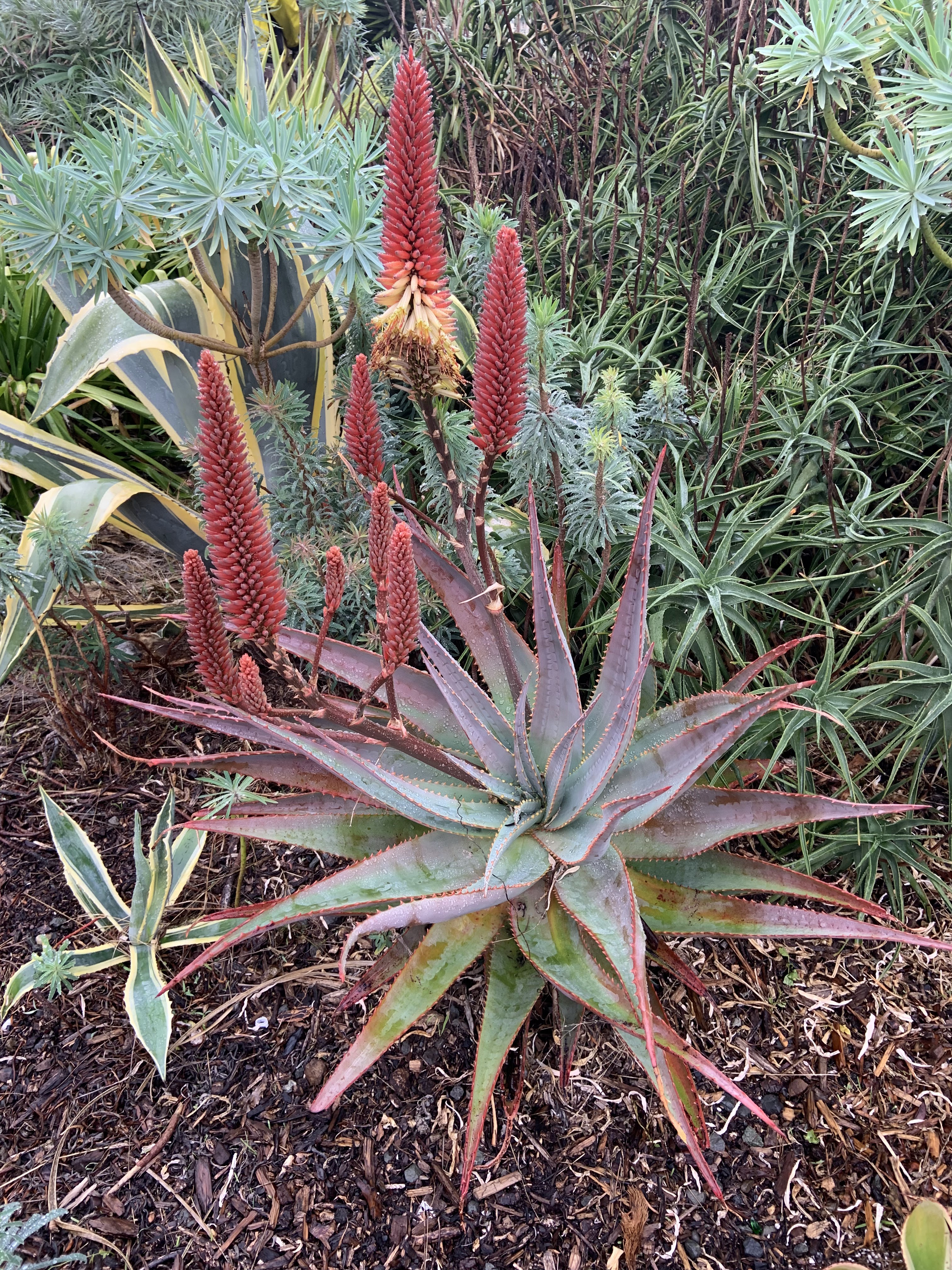
Photo: Lovely  Aloe "David Verity" that we got from Mat McGrath flowering away today.

Thursday, December 1, 2022

Adios, tool chest

No surprise in winter, but we got some good rain last night. The gardens will be LOVING it. Last week Matt and I popped out to PG and removed the tool chest from the back area.
We built that tool chest back in October of 2015 and it's given is 7 long years of use. but the sad fact is that as much as we fortified it over the years, it was honestly just sitting there waiting for people to break in and steal all our stuff. More recently we have only used it for equipment we don't mind losing, but a recent break-in made me give up - so the chest has sat empty for a while. We will reuse the wood for something else.

We also did some trimming and pruning, and noted that the last rain meant the weed seeds are sprouting. JUST when you think they are all gone - oh no. Also sprouting is the very first flower we have ever had on an Agave attenuata. It's going to be a crazy bloom: watch out for that!

We have a volunteer day this weekend - Saturday 10-12 as usual - and the GROWTH Project will be joining us again next week. Come on down and help prepare for more rains - we might even be planting stuff (The. Most. Fun!) if the ground is damp enough!
Tuesday, November 8, 2022

Rain! It's that time of year.

Our Volunteer Day on Saturday was fine and clear - we had a sprinkle of rain but it wasn't really noticeable.

Chris emptied the middle compost bin and spread the resulting product around the garden. We left the other bins open so they can get a soaking from the rains due this week. He also valiantly weeded what's left of the dried up weeds... who are right this moment charging up for a big flourish of growth thanks to aforementioned rain... *side eye*

Josh weeded the front bed and lots of other areas. I have to say, despite being dry it's looking pretty good. The Chasmanthe have started to sprout and that's always welcome at this time of year.

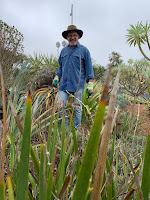
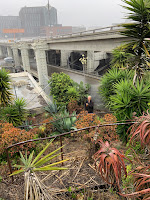
I cleared up lots of fallen cactus fruits around the front kiosk, and Chris helped by cutting flowers off the Yucca plants, which you can see him holding up in the first photo. Someone has been lopping the tops off the yucca plants to get the flowers - if you see anyone doing that tell them to knock it off! It damages the trees and makes them look ugly for a long time - it's so rude!

Today we're having lots of rain. The GROWTH Project team came by and we weeded the Triangle Garden through showers, and turned the compost which will soon be steaming away merrily. They're making a big impact on the garden, and I can't wait to see what they do next!

 
page counter
Free Hit Counter